Building the Future of Diamond OA: Reflections from the 3rd Global Summit
The EDCH was proud to participate in the 3rd Global Summit on Diamond Open Access, which took place in Bengaluru, India earlier this month. The Summit was sponsored by OPERAS, reflecting its commitment to supporting the global Diamond OA community. Our very own EDCH Co-coordinator, Johan Rooryck, was there to present the EDCH, an OPERAS programme, and participate in the Summit’s International Organisational Committee, and contribute to the global advancement of Diamond OA. The Diamond OA Summit is a uniquely positioned event that brings together researchers, editors, universities, research funding and performing organisations, academic libraries, learned societies, and policymakers engaged worldwide in strengthening and advancing the Diamond Open Access ecosystem.
The Summit in Bengaluru revolved around addressing key questions for the global Diamond OA ecosystem:
Can we scale sustainably?
Moving Diamond OA from a “niche” model to a consolidated, global infrastructure without losing community control.
How can we promote the idea of knowledge as a Digital public good”?
Aligning our platforms with national and global science policies to ensure they are treated as essential public infrastructure.
How do we change the “prestige” game?
Shifting research assessment so that authors are rewarded for choosing equitable, fee-free publishing over commercial journals.
Key themes that emerged
Across the plenary sessions, workshops, and thematic tracks, the Summit’s recurring themes centred on moving from the ideals of Diamond Open Access to a functional infrastructure for a global knowledge commons.
A major thread was the reimagining of equity. Discussions ranged from ensuring access to implementing active measures that support bibliodiversity and multilingualism. Participants emphasized that “non-commercial” should not simply mean “no fee,” but rather a truly community-owned collective capable of sustaining and growing the model.
This was complemented by a strong focus on policy convergence and infrastructure governance, as participants explored ways to link and bridge Diamond OA initiatives into a seamless, interoperable, and global “public good” network.
Finally, the theme of responsible research assessment surfaced as an essential bridge. Participants voiced a shared realisation that Diamond OA cannot truly grow and succeed unless metrics shift to value an equitable publishing ecosystem that embodies bibliodiversity, multilingualism, and epistemic justice over traditional, commercialised academic prestige.
Voices and perspectives in the room
The Summit was attended in person by 170 delegates from 28 countries, with an additional 180 participants from 33 countries attending online.
Strong delegations from Angola, Argentina, Belgium, India, Indonesia, Japan, France, México, Morocco, Mozambique, the Netherlands, the United States, and Québec were especially noteworthy, many of whom included representatives from governments or funding organisations. The largest delegation was from India, with 95 delegates present in person and 92 online. Participation varied across regions, and the Summit provided an opportunity to strengthen engagement with stakeholders and invite stronger participation from East and Southeast Asia in future events as they were underrepresented during the Summit.
Building on the community-building achieved at previous summits, interactions across regions were highly constructive. There was a strong sense of convergence around issues of community governance, research assessment reform, and sustainability through national, regional, and global infrastructures for Diamond OA.
Overheard in the room
“Impact factors are the fast food of research assessment: you don’t have to think.”
Mylène Deschênes, Fonds de Recherche du Québec (FRQ)
The EDCH and OPERAS were there to represent its motivated and passionate communities, participating in panels and workshops.
Watch back our contributions to the discussion:
🎬 Diamond OA initiatives (Key characteristics that make it work)
🎬 Diamond OA standards and capacity building
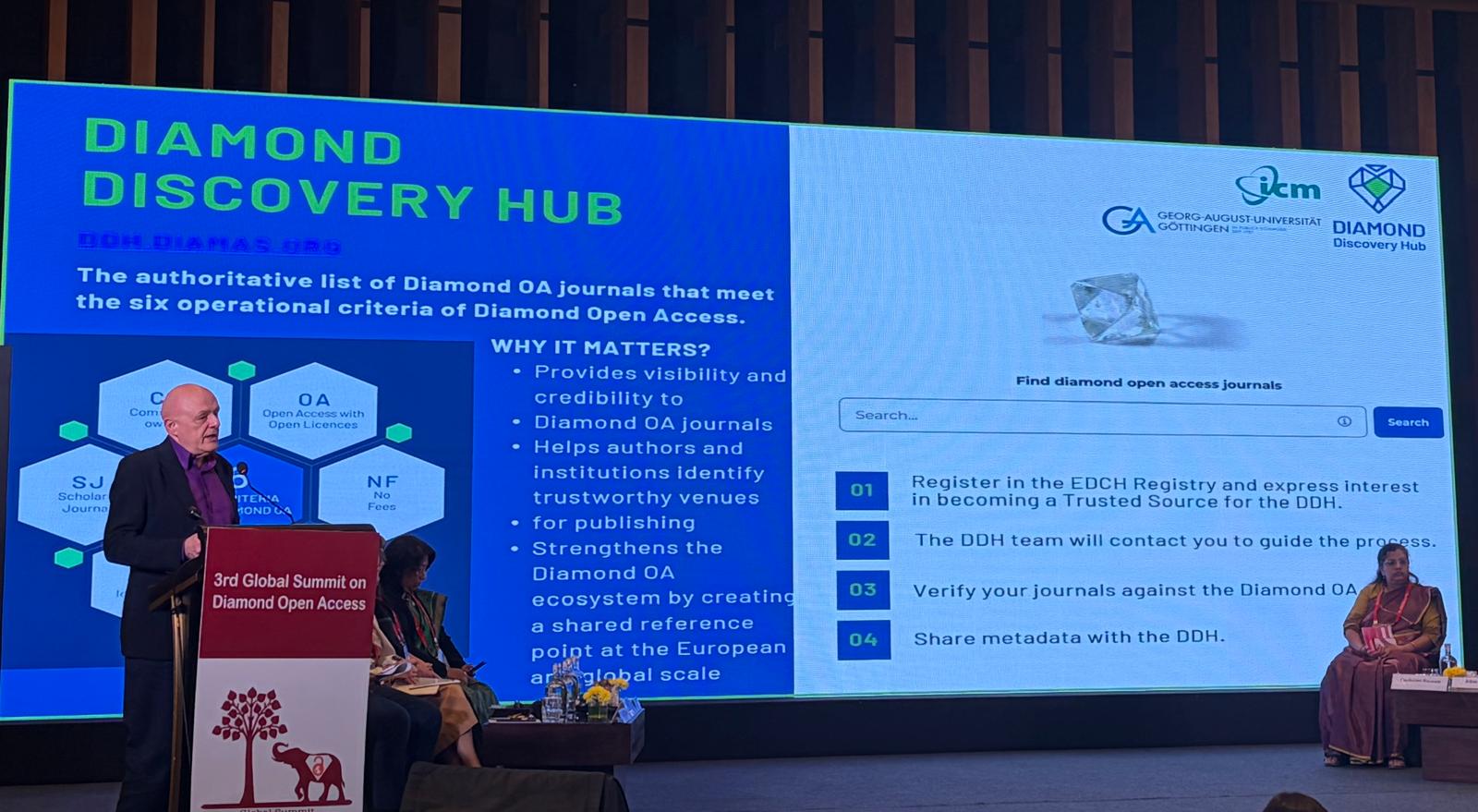
Johan Rooryck, EDCH Co-coordinator presenting the EDCH and the Diamond Discovery Hub (DDH)
What’s next?
A major outcome of the Summit is the Bengaluru Roadmap for Diamond OA. The Roadmap brings together shared objectives and actions identified during the Summit, while leaving space for regional, national, disciplinary, and institutional pathways to implementation. Its value lies not only in the recommendations it formulates, but also in the processes of alignment, mutual support, and accountability it seeks to encourage within the community.
Building on the shared vision articulated in previous Summits, the Bengaluru Roadmap is intended to evolve over time, informed by continued dialogue, evidence from practice, and renewed commitments from the global Diamond OA community. Its purpose and scope are to:
- Provide broad, actionable recommendations that can be adapted to regional, national, disciplinary, and institutional contexts.
- Align diverse initiatives within a coherent global undertaking, while respecting local autonomy and plurality.
The Roadmap will be finalized in the coming weeks. The next Global Summit will take place in Bali, Indonesia, in December 2027.
The EDCH and OPERAS will support the next global steps in Diamond OA by participating in the finalisation and implementation of the Bengaluru Roadmap. The EDCH also aims to ensure that its resources can be adopted and mirrored worldwide, with the goal of creating a strongly aligned global Diamond OA infrastructure.
Efforts to openly discuss and align essential resources such as training and the Diamond OA Standard are already underway in the ALMASI project, which brings together key Diamond OA actors in Africa, Latin America, and Europe.
Closing reflections
“I came away from the Bengaluru Summit with a sense of enthusiasm at the extent to which our common vision of Diamond OA is shared by other world regions: shared knowledge as a public good, publicly available infrastructure for running journals, ideas for strengthening community governance. Convergence is building faster than I had anticipated.”
Johan Rooryck, EDCH Co-coordinator
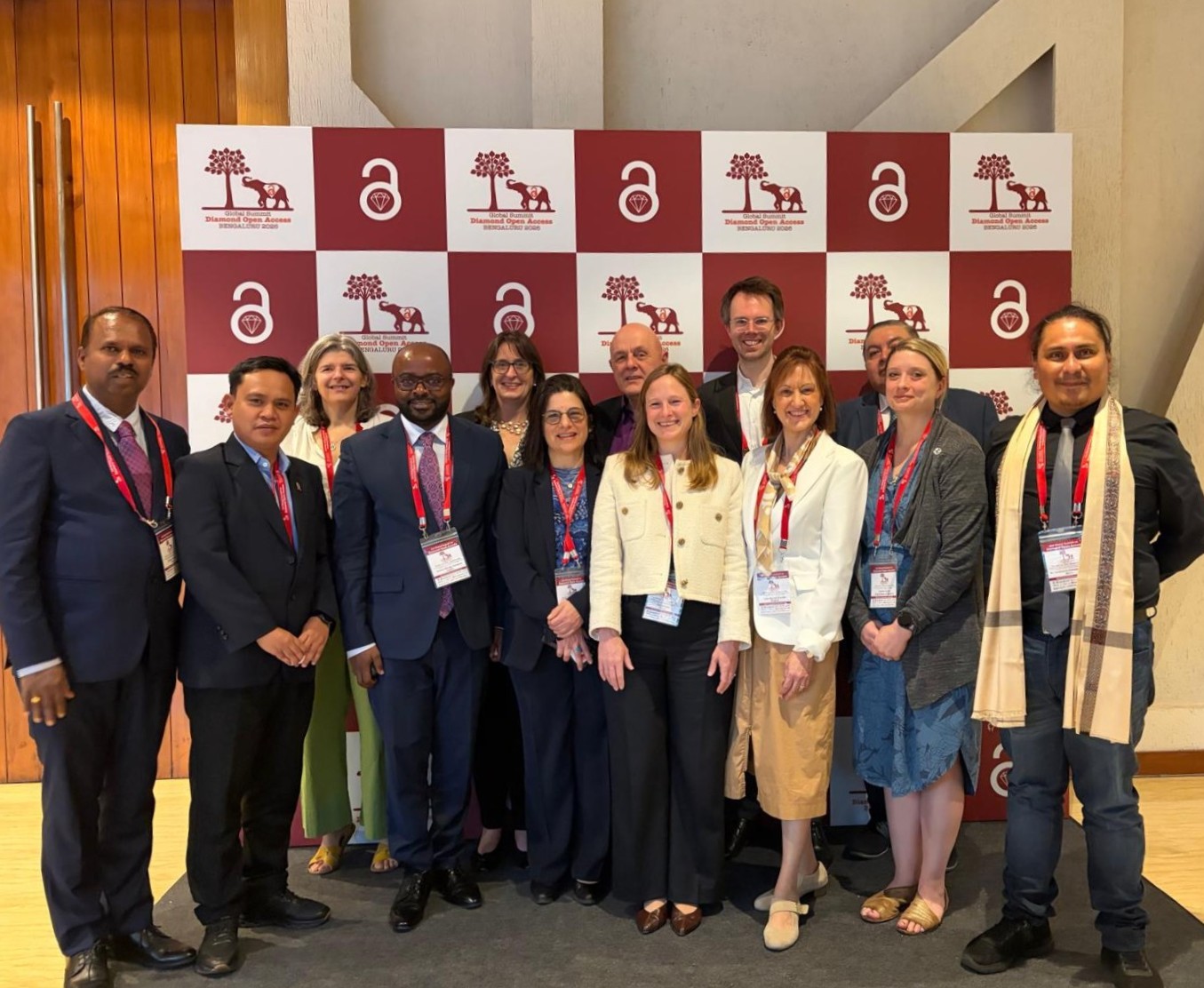
The International Organising Committee (IOC) - From left to right: Sridhar Gutam, Arbain Arbain, Joanna Ball, Mylène Deschênes, Zeynep Varoglu, Johan Rooryck, Lidia Borrell-Damián, David Oliva Uribe (behind Ashley Farley, Marco Estrada
We invite all Diamond OA stakeholders worldwide to engage with the EDCH and use, translate, and adapt our resources as widely as possible.
We would like to thank the co-organizers, delegates, and our Indian hosts for their commitment and engagement in making the 3rd Global Summit on Diamond Open Access a success. The vision, dialogue, and collective determination shown during the Summit will guide the work that lies ahead.